Buy komplizen.eu ?
We are moving the project
komplizen.eu .
Are you interested in purchasing the domain
komplizen.eu ?
domain@kv-gmbh.de · 0541-91531010
Buy komplizen.eu ?
What is a geostationary satellite physics task?
A geostationary satellite physics task involves calculating the necessary parameters for placing a satellite in geostationary orbit, such as the altitude, velocity, and orbital period. This task requires an understanding of the gravitational forces acting on the satellite, as well as the concept of geostationary orbit, where the satellite orbits the Earth at the same rate as the Earth's rotation, appearing stationary relative to a fixed point on the Earth's surface. Additionally, the task may involve determining the communication and observational capabilities of the satellite once in geostationary orbit. **
How do you calculate a geostationary satellite?
To calculate the orbit of a geostationary satellite, you would first need to determine the altitude at which the satellite needs to orbit in order to maintain a fixed position relative to the Earth's surface. This altitude is approximately 35,786 kilometers above the equator. Then, you would calculate the satellite's orbital period, which is the time it takes to complete one orbit around the Earth. This can be found using Kepler's third law, which relates the orbital period to the satellite's altitude. Finally, you would calculate the satellite's velocity using the formula for orbital velocity, which takes into account the gravitational pull of the Earth. **

Similar search terms for Geostationary
Top-Angebote
Products related to Geostationary:
-
Coach House Partners Tractor Metal Construction SetRecreate a familiar sight from rural life with the Coach House Partners Tractor Metal Construction Set. This detailed model celebrates the enduring role of the tractor in farming and agriculture, capturing the practical design and robust character of this essential working vehicle. The set includes 295 precision‑engineered stainless‑steel pieces, with the main body finished in a traditional green colour for an authentic appearance. Clear, colour step‑by‑step instructions guide you through the build, while the included specialist tools ensure everything needed is ready to use from the outset. Once completed, the model makes a compact and characterful display piece. With an estimated build time of two to four hours, this construction set offers a satisfying hands‑on project for teenagers and adults who enjoy detailed modelling. It also supports fine motor skills, patience and basic mechanical understanding. Parental guidance is recommended. Finished model dimensions: 12(H) x 12.8(W) x 29(D) cm. Recommended age: 12+.24,99 £*Shipping: 3,50 £Secure redirect to the provider
-
Kirby Star Allies US Nintendo Switch CD KeyKirby Star Allies is a platformer game for the Nintendo Switch where you play as Kirby. This time, Kirby isn't alone! You can team up with up to three friends (either other players or CPU-controlled characters) to battle your way through the game. Here's a rundown of the game: Teamwork makes the dream work: Inhale enemies and turn them into your allies, creating a powerful team with different abilities. Combine their powers to unleash Friend Abilities for devastating attacks. Platforming fun: The game is a side-scroller where you jump, fight, and solve puzzles along the way. Save the day: You'll face off against a villain named Hyness who is trying to destroy the universe with an ancient evil. Kirby Star Allies is a great game for both casual and hardcore gamers, with its cute characters, fun gameplay, and charming story.41,01 £*Shipping: 0,00 £Secure redirect to the provider
-
Coach House Partners Army Jeep Metal Construction SetRecreate a cornerstone of military vehicle history with the Coach House Partners Army Jeep Metal Construction Set. Based on the original Willys Army Jeep, this model pays tribute to the four‑wheel‑drive utility vehicle produced between 1941 and 1945, with over 600,000 built to support Allied forces during the Second World War. This detailed construction set includes 392 precision‑engineered stainless‑steel pieces, with the main body finished in a traditional green colour for an authentic appearance. Clear, colour step‑by‑step instructions guide the build, while the included specialist tools ensure everything required is ready to use from the outset. Once complete, the model captures the rugged proportions and practical design that made the Army Jeep so effective. With an estimated build time of three to five hours, the set offers a rewarding hands‑on project for teenagers and adults who enjoy detailed modelling. It also supports fine motor skills, patience and basic mechanical understanding. Parental guidance is recommended. Finished model dimensions: 11(H) x 13(W) x 26(D) cm. Recommended age: 12+.24,99 £*Shipping: 3,50 £Secure redirect to the provider
-
Coach House Partners Lancaster Bomber Metal Construction SetRecreate a landmark aircraft from aviation history with the Coach House Partners Lancaster Bomber Metal Construction Set. This detailed build pays tribute to the Avro Lancaster, best known for its role in major Second World War missions, including the historic Dambusters raid of 1943. Made up of 389 precision metal components, the set offers a rewarding hands‑on project that blends patience, problem‑solving and mechanical understanding. Clear, colour step‑by‑step instructions guide the build from start to finish, while the included specialist tools ensure everything needed is ready to use. The main body features a traditional green finish, giving the completed model an authentic, display‑worthy appearance. With an estimated build time of four to six hours, this construction set is designed for teenagers and adults who enjoy practical challenges and detailed modelling. It also supports the development of fine motor skills and basic engineering knowledge. Parental guidance is recommended. Finished model dimensions: 10(H) x 45(W) x 36(D) cm. Recommended age: 12+.24,99 £*Shipping: 3,50 £Secure redirect to the provider




-
Why do geostationary satellites need to be directly above the equator?
Geostationary satellites need to be directly above the equator because they orbit the Earth at the same rate that the Earth rotates on its axis. This allows the satellite to remain in a fixed position relative to the Earth's surface, making it ideal for communication and weather monitoring purposes. Being directly above the equator ensures that the satellite's orbit is aligned with the Earth's rotation, allowing it to maintain a constant position over a specific point on the equator. **
-
How do you calculate the orbital radius of a geostationary satellite?
The orbital radius of a geostationary satellite can be calculated using the formula for the radius of a circular orbit, which is given by: r = √(G*M*T^2 / 4π^2) Where: r = orbital radius G = gravitational constant (6.674 × 10^-11 N m^2/kg^2) M = mass of the Earth (5.972 × 10^24 kg) T = orbital period of the satellite (24 hours for a geostationary satellite) By plugging in the values for G, M, and T into the formula, you can calculate the orbital radius of a geostationary satellite. **
-
Why do geostationary satellites orbit at an altitude of around 36,000 kilometers?
Geostationary satellites orbit at an altitude of around 36,000 kilometers because at this height, their orbital period matches the rotation period of the Earth. This allows them to remain fixed relative to a specific point on the Earth's surface, making them ideal for applications such as communication and weather monitoring. Additionally, at this altitude, the satellites experience less gravitational pull, which helps to conserve fuel and extend their operational lifespan. **
-
Why do geostationary satellites fly at an altitude of around 36,000 kilometers?
Geostationary satellites are placed at an altitude of around 36,000 kilometers because at this height, their orbital period matches the Earth's rotation period. This allows them to remain fixed relative to a specific point on the Earth's surface, making them ideal for communication and weather monitoring purposes. Additionally, at this altitude, geostationary satellites have a wider coverage area and can maintain a constant line of sight with ground stations. **

Why do geostationary satellites fly at an altitude of approximately 36,000 km?
Geostationary satellites are placed at an altitude of approximately 36,000 km because at this height, their orbital period matches the Earth's rotation period, allowing them to remain fixed relative to a specific point on the Earth's surface. This stationary position is ideal for applications such as communication and weather monitoring, as the satellite can maintain constant contact with a specific location on the ground. Additionally, the higher altitude provides a wider coverage area for the satellite's signals. **
How high is the energy of a geostationary satellite compared to Earth?
The energy of a geostationary satellite is higher than that of Earth due to its higher altitude and velocity. Geostationary satellites orbit at an altitude of approximately 35,786 kilometers above the Earth's surface, which requires a significant amount of energy to maintain. Additionally, these satellites must travel at a speed that matches the rotation of the Earth, further increasing their energy compared to objects on the Earth's surface. **
Top-Angebote
Products related to Geostationary:
-
Coach House Partners Spitfire Metal Construction SetCelebrate one of Britain’s most iconic aircraft with the Coach House Partners Spitfire Metal Construction Set. Designed as a detailed, hands‑on build, this model pays tribute to the legendary Spitfire, a symbol of British engineering and aviation history. With 285 precision metal components, this construction set offers a rewarding build that balances challenge with clarity. Clear, colour step‑by‑step instructions guide you through the process, while the included specialist tools ensure everything you need is close at hand. Once complete, the finished model makes an impressive display piece, showcasing the distinctive shape and presence of the original aircraft. Ideal for teenagers and adults alike, this set encourages patience, problem‑solving and practical engineering skills. Expect a build time of around three to five hours, making it a satisfying project rather than a quick assembly. Finished model dimensions: 11(H) x 40(W) x 35(D) cm. Recommended age: 12+ (parental guidance advised).24,99 £*Shipping: 3,50 £Secure redirect to the provider
-
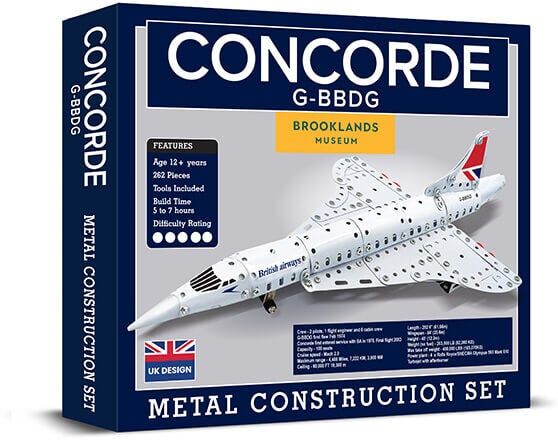
Coach House Partners Concorde Metal Construction SetRecreate one of the most extraordinary achievements in aviation history with the Coach House Partners Concorde Metal Construction Set. Developed in association with Brooklands Museum, Weybridge, this detailed model represents British Airways Concorde G‑BBDG, which took its maiden flight in February 1974. Concorde was a British‑French turbojet aircraft capable of flying at over twice the speed of sound, transforming long‑distance travel by cutting transatlantic flight times to just a few hours. This construction set captures the sleek proportions and distinctive design that made Concorde an enduring symbol of innovation and luxury air travel. Comprising 269 precision‑engineered stainless‑steel pieces, the set offers a challenging and rewarding build for those who enjoy detailed modelling projects. Clear, colour step‑by‑step instructions guide the process, while the included specialist tools ensure everything needed is ready to use. With an estimated build time of five to seven hours, this is a satisfying project that results in an impressive display model. Designed for teenagers and adults, the set also supports the development of fine motor skills, patience and basic mechanical understanding. Parental guidance is recommended. Finished model dimensions: 14(H) x 24(W) x 52(D) cm. Recommended age: 12+.24,99 £*Shipping: 3,50 £Secure redirect to the provider
-
Coach House Partners Tractor Metal Construction SetRecreate a familiar sight from rural life with the Coach House Partners Tractor Metal Construction Set. This detailed model celebrates the enduring role of the tractor in farming and agriculture, capturing the practical design and robust character of this essential working vehicle. The set includes 295 precision‑engineered stainless‑steel pieces, with the main body finished in a traditional green colour for an authentic appearance. Clear, colour step‑by‑step instructions guide you through the build, while the included specialist tools ensure everything needed is ready to use from the outset. Once completed, the model makes a compact and characterful display piece. With an estimated build time of two to four hours, this construction set offers a satisfying hands‑on project for teenagers and adults who enjoy detailed modelling. It also supports fine motor skills, patience and basic mechanical understanding. Parental guidance is recommended. Finished model dimensions: 12(H) x 12.8(W) x 29(D) cm. Recommended age: 12+.24,99 £*Shipping: 3,50 £Secure redirect to the provider
-
Kirby Star Allies US Nintendo Switch CD KeyKirby Star Allies is a platformer game for the Nintendo Switch where you play as Kirby. This time, Kirby isn't alone! You can team up with up to three friends (either other players or CPU-controlled characters) to battle your way through the game. Here's a rundown of the game: Teamwork makes the dream work: Inhale enemies and turn them into your allies, creating a powerful team with different abilities. Combine their powers to unleash Friend Abilities for devastating attacks. Platforming fun: The game is a side-scroller where you jump, fight, and solve puzzles along the way. Save the day: You'll face off against a villain named Hyness who is trying to destroy the universe with an ancient evil. Kirby Star Allies is a great game for both casual and hardcore gamers, with its cute characters, fun gameplay, and charming story.41,01 £*Shipping: 0,00 £Secure redirect to the provider
-
What is a geostationary satellite physics task?
A geostationary satellite physics task involves calculating the necessary parameters for placing a satellite in geostationary orbit, such as the altitude, velocity, and orbital period. This task requires an understanding of the gravitational forces acting on the satellite, as well as the concept of geostationary orbit, where the satellite orbits the Earth at the same rate as the Earth's rotation, appearing stationary relative to a fixed point on the Earth's surface. Additionally, the task may involve determining the communication and observational capabilities of the satellite once in geostationary orbit. **
-
How do you calculate a geostationary satellite?
To calculate the orbit of a geostationary satellite, you would first need to determine the altitude at which the satellite needs to orbit in order to maintain a fixed position relative to the Earth's surface. This altitude is approximately 35,786 kilometers above the equator. Then, you would calculate the satellite's orbital period, which is the time it takes to complete one orbit around the Earth. This can be found using Kepler's third law, which relates the orbital period to the satellite's altitude. Finally, you would calculate the satellite's velocity using the formula for orbital velocity, which takes into account the gravitational pull of the Earth. **
-
Why do geostationary satellites need to be directly above the equator?
Geostationary satellites need to be directly above the equator because they orbit the Earth at the same rate that the Earth rotates on its axis. This allows the satellite to remain in a fixed position relative to the Earth's surface, making it ideal for communication and weather monitoring purposes. Being directly above the equator ensures that the satellite's orbit is aligned with the Earth's rotation, allowing it to maintain a constant position over a specific point on the equator. **
-
How do you calculate the orbital radius of a geostationary satellite?
The orbital radius of a geostationary satellite can be calculated using the formula for the radius of a circular orbit, which is given by: r = √(G*M*T^2 / 4π^2) Where: r = orbital radius G = gravitational constant (6.674 × 10^-11 N m^2/kg^2) M = mass of the Earth (5.972 × 10^24 kg) T = orbital period of the satellite (24 hours for a geostationary satellite) By plugging in the values for G, M, and T into the formula, you can calculate the orbital radius of a geostationary satellite. **
Similar search terms for Geostationary
-
Coach House Partners Army Jeep Metal Construction SetRecreate a cornerstone of military vehicle history with the Coach House Partners Army Jeep Metal Construction Set. Based on the original Willys Army Jeep, this model pays tribute to the four‑wheel‑drive utility vehicle produced between 1941 and 1945, with over 600,000 built to support Allied forces during the Second World War. This detailed construction set includes 392 precision‑engineered stainless‑steel pieces, with the main body finished in a traditional green colour for an authentic appearance. Clear, colour step‑by‑step instructions guide the build, while the included specialist tools ensure everything required is ready to use from the outset. Once complete, the model captures the rugged proportions and practical design that made the Army Jeep so effective. With an estimated build time of three to five hours, the set offers a rewarding hands‑on project for teenagers and adults who enjoy detailed modelling. It also supports fine motor skills, patience and basic mechanical understanding. Parental guidance is recommended. Finished model dimensions: 11(H) x 13(W) x 26(D) cm. Recommended age: 12+.24,99 £*Shipping: 3,50 £Secure redirect to the provider
-
Coach House Partners Lancaster Bomber Metal Construction SetRecreate a landmark aircraft from aviation history with the Coach House Partners Lancaster Bomber Metal Construction Set. This detailed build pays tribute to the Avro Lancaster, best known for its role in major Second World War missions, including the historic Dambusters raid of 1943. Made up of 389 precision metal components, the set offers a rewarding hands‑on project that blends patience, problem‑solving and mechanical understanding. Clear, colour step‑by‑step instructions guide the build from start to finish, while the included specialist tools ensure everything needed is ready to use. The main body features a traditional green finish, giving the completed model an authentic, display‑worthy appearance. With an estimated build time of four to six hours, this construction set is designed for teenagers and adults who enjoy practical challenges and detailed modelling. It also supports the development of fine motor skills and basic engineering knowledge. Parental guidance is recommended. Finished model dimensions: 10(H) x 45(W) x 36(D) cm. Recommended age: 12+.24,99 £*Shipping: 3,50 £Secure redirect to the provider
-
Coach House Partners Sherman Tank Metal Construction SetRecreate one of the most significant armoured vehicles of the Second World War with the Coach House Partners Sherman Tank Metal Construction Set. Widely used by Allied forces, the Sherman Tank was produced in vast numbers between 1942 and 1945 and became a defining symbol of wartime engineering and battlefield versatility. This detailed construction set includes 284 precision‑engineered stainless‑steel pieces, with the main body finished in a traditional green colour for an authentic look. Clear, colour step‑by‑step instructions guide the build, while the included specialist tools ensure everything required is ready to use from the outset. Once completed, the model makes a compact yet striking display piece. With an estimated build time of three to five hours, the set offers a rewarding hands‑on project for teenagers and adults who enjoy detailed modelling. It also supports fine motor skills, patience and basic mechanical understanding. Parental guidance is recommended. Finished model dimensions: 12(H) x 11(W) x 16(D) cm. Recommended age: 12+.24,99 £*Shipping: 3,50 £Secure redirect to the provider
-
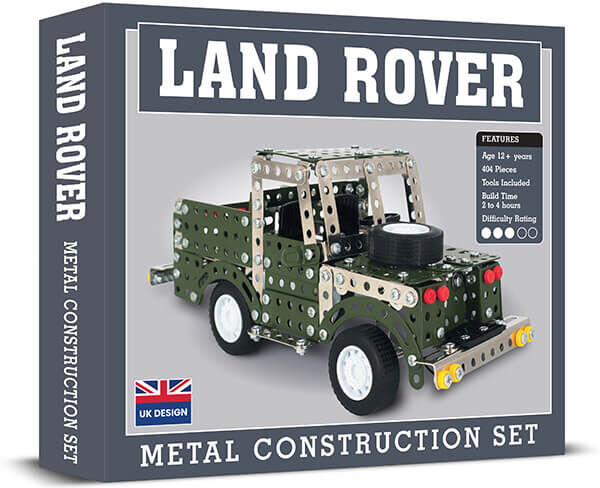
Coach House Partners Land Rover Metal Construction SetBuild a true automotive icon with the Coach House Partners Land Rover Metal Construction Set. First conceived by Maurice Wilks in 1947 and launched in 1948, the Land Rover became a benchmark for rugged, go‑anywhere 4x4 design. This detailed model celebrates the engineering heritage that made it a cornerstone of off‑road motoring. The set features 402 precision‑engineered stainless‑steel pieces, offering a hands‑on build that balances detail with approachability. Clear, colour step‑by‑step instructions guide you through the construction process, while the included specialist tools ensure everything needed is ready to use from the start. Once complete, the model makes a distinctive display piece that reflects the Land Rover’s unmistakable shape and utility‑driven design. With an estimated build time of two to four hours, this construction set is well suited to teenagers and adults who enjoy practical modelling projects. It also supports the development of fine motor skills, patience and basic mechanical understanding. Parental guidance is recommended. Finished model dimensions: 12(H) x 13(W) x 28(D) cm. Recommended age: 12+.24,99 £*Shipping: 3,50 £Secure redirect to the provider
-
Why do geostationary satellites orbit at an altitude of around 36,000 kilometers?
Geostationary satellites orbit at an altitude of around 36,000 kilometers because at this height, their orbital period matches the rotation period of the Earth. This allows them to remain fixed relative to a specific point on the Earth's surface, making them ideal for applications such as communication and weather monitoring. Additionally, at this altitude, the satellites experience less gravitational pull, which helps to conserve fuel and extend their operational lifespan. **
-
Why do geostationary satellites fly at an altitude of around 36,000 kilometers?
Geostationary satellites are placed at an altitude of around 36,000 kilometers because at this height, their orbital period matches the Earth's rotation period. This allows them to remain fixed relative to a specific point on the Earth's surface, making them ideal for communication and weather monitoring purposes. Additionally, at this altitude, geostationary satellites have a wider coverage area and can maintain a constant line of sight with ground stations. **
-
Why do geostationary satellites fly at an altitude of approximately 36,000 km?
Geostationary satellites are placed at an altitude of approximately 36,000 km because at this height, their orbital period matches the Earth's rotation period, allowing them to remain fixed relative to a specific point on the Earth's surface. This stationary position is ideal for applications such as communication and weather monitoring, as the satellite can maintain constant contact with a specific location on the ground. Additionally, the higher altitude provides a wider coverage area for the satellite's signals. **
-
How high is the energy of a geostationary satellite compared to Earth?
The energy of a geostationary satellite is higher than that of Earth due to its higher altitude and velocity. Geostationary satellites orbit at an altitude of approximately 35,786 kilometers above the Earth's surface, which requires a significant amount of energy to maintain. Additionally, these satellites must travel at a speed that matches the rotation of the Earth, further increasing their energy compared to objects on the Earth's surface. **
* All prices are inclusive of VAT and, if applicable, plus shipping costs. The offer information is based on the details provided by the respective shop and is updated through automated processes. Real-time updates do not occur, so deviations can occur in individual cases. ** Note: Parts of this content were created by AI.